



2026/09/17
[Regular Series] Urban Greening and Disaster Prevention ③ ~Ancient Words and Measures Against Heavy Rain~
Rooftop and wall greening
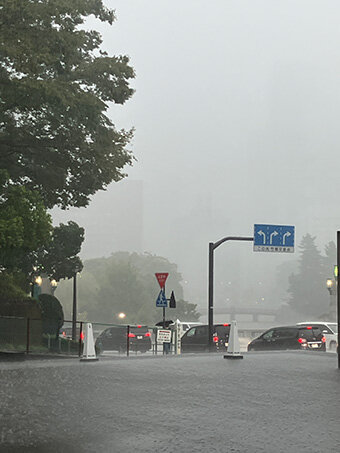 On August 13, 2026, a linear rainband formed in the Kanto region, resulting in record-breaking heavy rainfall in Chiba Prefecture. Urban areas experienced inland flooding, and videos shared on social media showed roads resembling rivers with cars stranded everywhere. In addition to flooding of homes, disruptions to railways and power outages, there were also reports of casualties, resulting in widespread damage.
Around the same time, I also experienced the same heavy rain in Kanagawa, but since I had gone out without an umbrella, it felt less like my body got wet and more like a bucket of water had been poured over my head. The roads were flooded in an instant, and although I've come to experience something similar every year and no longer panic, I was surprised by the extent of the damage when I later heard the news from Chiba.
I would like to express my deepest sympathies to all those who have been affected.
Heavy rain and ancient words
Such sudden, localized thunderstorms may not be a recent phenomenon. Upon investigation, the word "shūu" (驟雨) appears in the Nara period historical text, "Shoku Nihongi." The "shū" in shūu means "a horse galloping," and it is said to describe rain that comes at the speed of a horse galloping, referring to sudden, heavy rain. It could be said to be a description of localized, intense rain that is reminiscent of modern-day guerrilla downpours.
The Shoku Nihongi states, "There was a sudden downpour in the capital. Water puddles overflowed everywhere. Also, the embankments of Kijin and Ibarada often collapsed." This was recorded on the 24th day of the 5th month of the 2nd year of Tenpyō Shōhō (750 AD). Water puddles refer to water that has accumulated on the ground due to heavy rain, and overflow refers to the way water overflows and spreads. It seems that even in the capital at that time, heavy rain caused the ground to overflow, and the embankments of Kijin and Ibarada collapsed, causing great damage. Although it cannot be said that this was exactly the same as modern inland flooding, it can be seen that the capital has been troubled by floods caused by rain since the ancient Nara period.
There are other archaic words related to rain, such as "hakuu" (white rain), "murasame" (sudden shower), "shigeame" (continuous rain), and "shinotsukiku ame" (thrusting rain). Hakuu is a sudden, heavy downpour that appears white. Murasame is rain that falls heavily for a short time and then stops quickly. Shigeame is rain that falls without ceasing. Shinotsukiku ame describes rain that falls straight down heavily, like bundles of thin bamboo being thrust down.
Thus, rather than simply fearing rain, people in the past likely observed it closely enough to express its various characteristics in words and even give it names. It is easy to imagine that they accepted and observed the workings of nature, and while dealing with floods, they accumulated flood control techniques.
So, how should we deal with rain in modern times? Until now, urban rainwater management has been based on collecting rainwater in gutters and sewers and draining it into rivers as quickly as possible. However, if torrential rain falls in a short period of time, it exceeds the drainage capacity of the sewers, and the rainwater, having nowhere else to go, overflows onto the roads. This is the inland flooding that frequently occurs in cities. So, instead of "draining" the rain immediately, wouldn't it be possible to temporarily collect and store the rainwater where it falls, and then release it slowly?
A small dam on the rooftop
In the mountains, forests absorb the rain. In rural areas, rice paddies store the rain. In parks and green spaces, the soil allows the rain to permeate. And in densely populated cities, there is still a place that can be used: rooftops.

This simultaneously satisfies two legal regulations: "reducing rainwater runoff" and "securing green space."
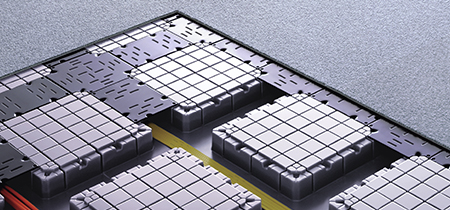
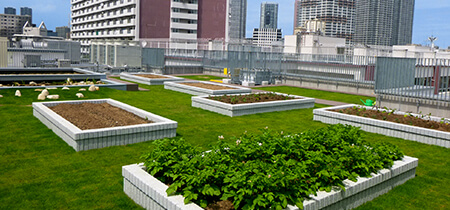
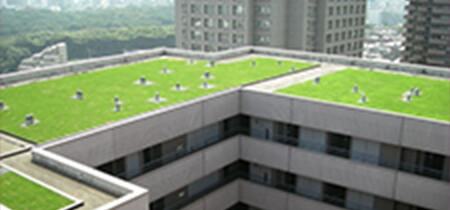
Our "Square Turf KOZUIMUYO" utilizes rooftops to serve two purposes: controlling rainwater runoff and promoting greening. It is used on the rooftops of various buildings in cities to create systems that collect rainwater and allow it to drain slowly.Recently, we installed the "Square Turf KOZUIMUYO" rainwater storage rooftop greening system on the roof of the Setagaya Ward Office building.
When we think of rooftop greening, we often picture planting vegetation to improve the landscape and mitigate the urban heat island effect. However, "Square Turf KOZUIMUYO" aims for more than just that. It collects rainwater that falls on the roof, temporarily stores it, and prevents it from flowing all at once into the sewer system. In other words, it's a "small dam" built on top of urban buildings.
A single rooftop can only hold a limited amount of rain. But what if the countless rooftops in a city—schools, government buildings, offices, hospitals, factories, logistics facilities, commercial buildings, apartment buildings, and so on—each held a little bit of rain? If a single drop of rain is collected in one place, it will cause a flood. However, if that single drop can be absorbed little by little where it falls, it can help mitigate water damage. This is similar to the concept of "basin-wide flood control" that is currently being promoted.
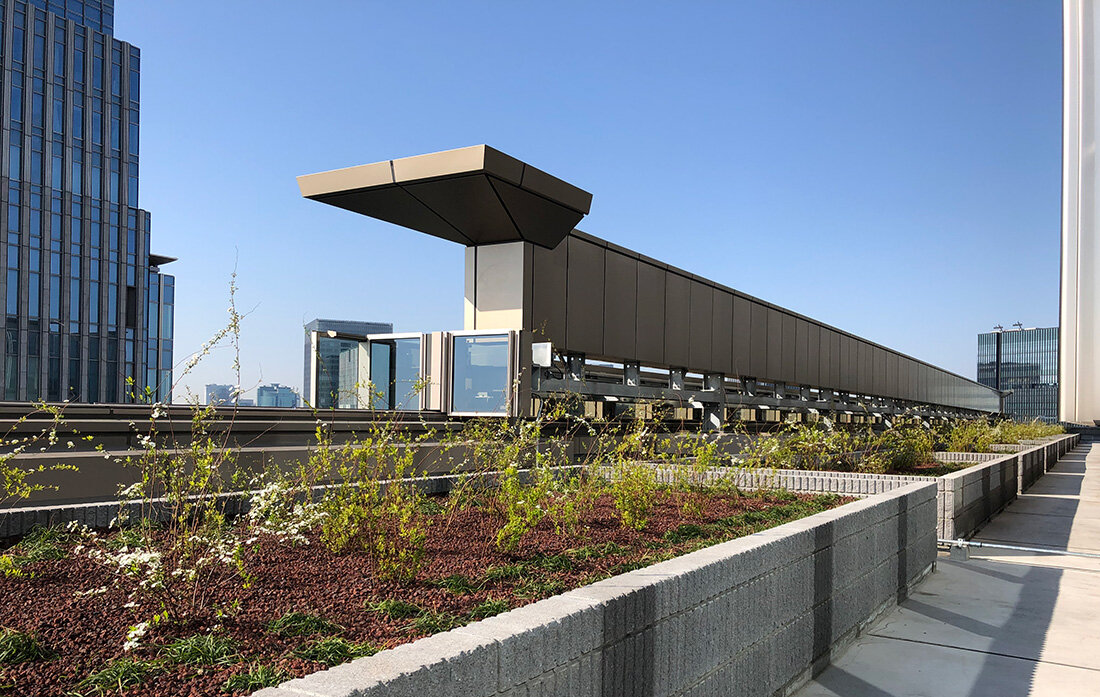
■Rainwater runoff suppression rooftop greening system "Square Turf KOZUIMUYO" installed on the rooftop
We don't leave flood control solely to rivers. Nor do we entrust it to facilities that store rainwater in vast underground spaces. Forests receive the water, rice paddies store it, parks and rain gardens allow it to permeate, and in cities, even the rooftops of buildings receive it. Each and every one of us living in the river basin takes on a small part of the water.The wisdom of our ancestors and future flood control
Sudden showers, intermittent rain, heavy downpours, torrential rain—
Our ancestors carefully observed the different facets of rain, giving them names, and lived in harmony with both the blessings of water and its threats. Now that the climate is changing and cities are evolving, isn't it time for us, too, to consider new ways of interacting with rain?
We hope that the rooftop greening project we completed on the Setagaya Ward Office building in 2026 will become one example of this new form of flood control.
Writing/Responsibility
KYODO KY-TEC Co., Ltd. Environmental Business Department
Masayoshi Kawaguchi